


Commercial interior fabrication is what turns a space from somewhere people pass through into somewhere people remember. It is the discipline that connects brand strategy to physical reality, taking concepts, values, and identity and building them into the walls, floors, ceilings, and surfaces of permanent commercial environments.
When it is done well, the space does not feel designed. It feels inevitable. Visitors understand the brand before anyone says a word. Employees feel the culture in the environment they show up to every day. Clients form opinions about your company based on what they see, touch, and experience the moment they walk in.
This guide covers everything that goes into commercial interior fabrication and branded environments, from the foundational elements and the process behind them to the verticals that rely on them most and what separates a space that performs from one that just looks good in photos.
Table of Contents
- What Is Commercial Interior Fabrication?
- Who Needs Commercial Interior Fabrication?
- The Building Blocks of a Branded Environment
- The Commercial Interior Fabrication Process
- What Makes a Branded Environment Actually Work
- Permanent vs Temporary: Knowing the Difference
- How to Choose the Right Commercial Interior Fabricator
- What We Have Learned Building Branded Environments
- Frequently Asked Questions
What Is Commercial Interior Fabrication?
Commercial interior fabrication is the custom building of interior elements for business environments. Unlike ordering standard fixtures from a catalog, fabrication is tailored to the brand, the space, and the experience the organization wants people to have.
That can include dimensional logos and lettering, feature walls, branded displays, custom millwork and cabinetry, architectural accents, integrated lighting, wayfinding systems, and immersive brand installations. Every element is designed and built to serve a specific purpose in a specific space.
The difference between commercial interior fabrication and basic interior design is strategy. Design focuses on how a space looks and functions. Fabrication connects that space to brand identity. It answers questions like what people should understand about this company the moment they walk in, what employees should feel every day, and how the physical environment should reflect the organization’s values, culture, and quality standards.
When fabrication is treated as part of the brand strategy rather than a late-stage vendor handoff, the result is a space that communicates consistently across every touchpoint, from the entrance to the conference room to the corridor between them.
Who Needs Commercial Interior Fabrication?
Commercial interior fabrication is valuable for any organization where the physical space plays a role in how the brand is experienced. That covers a wide range of verticals.
Corporate offices and headquarters For companies that host clients, recruit talent, and house teams every day, the office is a brand asset. Office environmental branding turns a generic workspace into a physical expression of company identity, culture, and quality. When the environment reflects the brand, employees feel it and visitors notice it.
Retail environments Retail interior branding directly affects customer behavior. It shapes trust, guides attention, increases dwell time, and supports conversion. For brands investing in permanent retail interiors, the space itself becomes part of the sales process.
Hospitality brands Hotels, restaurants, and resorts use hospitality interior design to build brand identity before a single interaction takes place. The space communicates who the brand is, what kind of experience to expect, and whether it is worth coming back to. Restaurant interior branding and hotel interior branding operate on the same principle: the physical environment is the product as much as anything on the menu or in the room.
Automotive dealerships Dealership interior branding influences buying decisions by shaping how customers feel before the sales conversation even starts. A polished, cohesive showroom environment builds trust, reduces friction, and helps customers picture themselves doing business with you.
Museums, aquariums, and zoos These environments rely on museum exhibit fabrication and aquarium and zoo exhibit fabrication to turn raw space into immersive, educational experiences. Custom fabrication handles the scenic elements, interactive features, interpretive displays, and durable materials that public environments demand.
Corporate campuses and headquarters Large-scale environments require corporate campus branding systems that make multiple buildings feel like one connected brand. Consistency across signage, wayfinding, materials, and environmental graphics is what keeps a campus from feeling scattered.
Agencies and design teams Marketing agencies, architects, and interior designers often rely on commercial interior fabricators as production partners. They bring the concept. The fabricator brings the capability to build it correctly, on time, and on budget.
The Building Blocks of a Branded Environment
A fully branded commercial environment is made up of individual elements that work together as a system. Here is what that system typically includes.
Lobby feature walls and entry statements The arrival sequence sets the tone for everything that follows. A strong lobby feature wall design creates a clear brand focal point the moment someone walks in, using materials, lighting, and dimensional elements to communicate identity before anyone speaks.
Branded reception areas Branded reception area design extends the arrival experience to the first point of human interaction. Materials, signage, lighting, and layout all contribute to the impression formed in the first few seconds of a visit.
Dimensional letter signage Dimensional letter signage adds depth, polish, and permanence to branded environments. Individual fabricated letters and logos mounted to walls, facades, or interior features create a finished look that flat graphics cannot replicate.
Office wayfinding signage Office wayfinding signage keeps people moving confidently through a space without confusion. A well-designed wayfinding system is branded but never distracting, functional but never generic.
Culture walls and values installations Culture wall design turns abstract company values into something physical and visible. Mission statements, company history, team values, and brand milestones can all be built into the environment in a way that employees experience every day.
Conference room branding Conference room branding makes meeting spaces feel intentional rather than interchangeable. Branded materials, graphics, and dimensional elements turn a standard room into a space that reinforces the company’s identity to everyone who uses it.
Branded hallway and floor graphics Branded hallway graphics extend the brand through transitional spaces that most companies leave untouched. Hallways and floors connect every part of the environment, which makes them one of the most underused branding opportunities in any commercial interior.
Employee experience design Employee experience design treats the workplace as an active tool for culture, collaboration, and performance. When the physical environment reflects how people actually work, the space supports the business rather than simply housing it.
The Commercial Interior Fabrication Process
A well-run commercial interior fabrication project follows a clear sequence. Understanding each phase helps organizations plan better, avoid surprises, and get more out of their investment.
Discovery Every project starts with understanding what the space needs to do, who uses it, and what the brand should communicate. Budget range, timeline, site conditions, and brand standards are all established at this stage. Skipping this step is where most projects go wrong.
Site survey A site survey uncovers the real conditions that shape the project: wall types, ceiling heights, lighting, access windows, power availability, floor conditions, and building restrictions. What looks clean in a rendering may need to change once the actual space is measured and assessed.
Concept design This is where brand strategy becomes a physical plan. The design team develops the visual and material direction for each space, balancing brand intent with real-world constraints like budget, timeline, and building conditions.
Engineering and fabrication planning Once designs are approved, shop drawings, material specifications, mounting details, and sequencing are locked in. This phase protects the project from surprises during production and installation. For more detail on what this looks like in practice, the full interior branding project breakdown covers each phase in depth.
Fabrication Production begins once approvals are in place. Depending on the scope, this can involve printing, CNC cutting, welding, painting, finishing, assembly, and quality control across multiple material types. Permanent interiors require fabrication precision that event builds often do not.
Installation Installation is where planning gets tested. Site access, scheduling, coordination with other trades, and clean finishing all determine whether the project lands the way it was designed. A strong fabrication partner owns the install, not just the build.
If you are working with a commercial interior fabricator for the first time, understanding what to expect at each stage prevents the most common planning mistakes.
What Makes a Branded Environment Actually Work
Not every branded space performs. The ones that do share a few characteristics that go beyond aesthetics.
Strategy before materials The strongest branded environments start with a clear brief. What should people understand when they walk in? What should employees feel every day? What story does this space need to tell? Without those answers, design decisions default to preference rather than purpose.
Consistency across every touchpoint A strong lobby that leads to a generic hallway, an uninspired conference room, and a bare reception desk sends a mixed message. Branded environments work when every element from the entrance to the exit contributes to the same experience. That consistency is what makes a space feel intentional rather than assembled.
Materials chosen for the long haul Permanent interiors carry a different standard than event builds. Materials need to hold up to daily use, cleaning, sunlight, and foot traffic. A finish that looks premium on day one but chips within a year is not a win. The right fabrication partner helps organizations choose materials that balance appearance, durability, and cost from the beginning.
Brand alignment at every level The space should feel like it belongs to the same brand as the website, the trade show program, the sales materials, and the customer experience. When that alignment is present, the brand feels stronger and more credible. When it is absent, even a beautifully designed space feels off.
Function alongside form A beautiful space that confuses visitors, disrupts workflow, or makes maintenance difficult has not solved the problem. The best commercial interior fabrication combines visual impact with operational intelligence, designing environments that look sharp and work well every single day.
Permanent vs Temporary: Knowing the Difference
Not every branded build needs to last forever. Understanding the distinction between permanent interior installations and temporary event builds helps organizations make smarter investment decisions.
Permanent installations are designed for daily use over years. They work best in corporate offices, retail environments, lobbies, showrooms, campuses, and anywhere the brand experience needs to be consistent and long-lasting. They require higher-grade materials, more detailed engineering, and installation that integrates cleanly with the existing architecture.
Temporary builds are designed for flexibility and short-term use. They work best for trade shows, pop-ups, events, product launches, and traveling activations. They prioritize portability, speed, and the ability to reconfigure across different footprints.
The biggest mistake is using the wrong solution for the job. A temporary display in a flagship lobby can undermine the brand. A permanent-grade build for a three-day event can waste budget that should have gone toward a more reusable solution. The decision should always start with how long the space needs to perform and what kind of return the investment needs to deliver.
How to Choose the Right Commercial Interior Fabricator
The fabricator you choose shapes the outcome of the project as much as the design does. Here is what to look for.
Full-scope capability The strongest partners can handle design translation, engineering, fabrication, and installation under one roof. Handoff gaps between separate vendors are where projects lose alignment, budget, and time.
Experience across verticals A fabricator who has built branded environments for corporate offices, retail spaces, hospitality brands, dealerships, and exhibit environments brings perspective that single-category specialists cannot. They understand the different durability standards, installation constraints, and brand considerations that each vertical requires.
Honest communication A good fabricator does not just say yes to the concept. They ask the questions that protect the project later: Can this wall support the weight? Will this finish hold up in a high-traffic environment? Can this be serviced after installation? That kind of proactive problem-solving is worth more than a smooth sales presentation.
A track record of finished environments Renderings are easy. Finished spaces are the real proof. Ask to see completed projects, not just concepts. The quality of a fabricator shows up in the alignment, the edge details, the finish consistency, and the way the space holds up over time.
Project management discipline Timeline and budget predictability come from process, not promises. Ask how the partner manages approvals, material lead times, site access, and scope changes. A fabricator with a clear process creates fewer surprises and delivers more consistent outcomes.
What We Have Learned Building Branded Environments
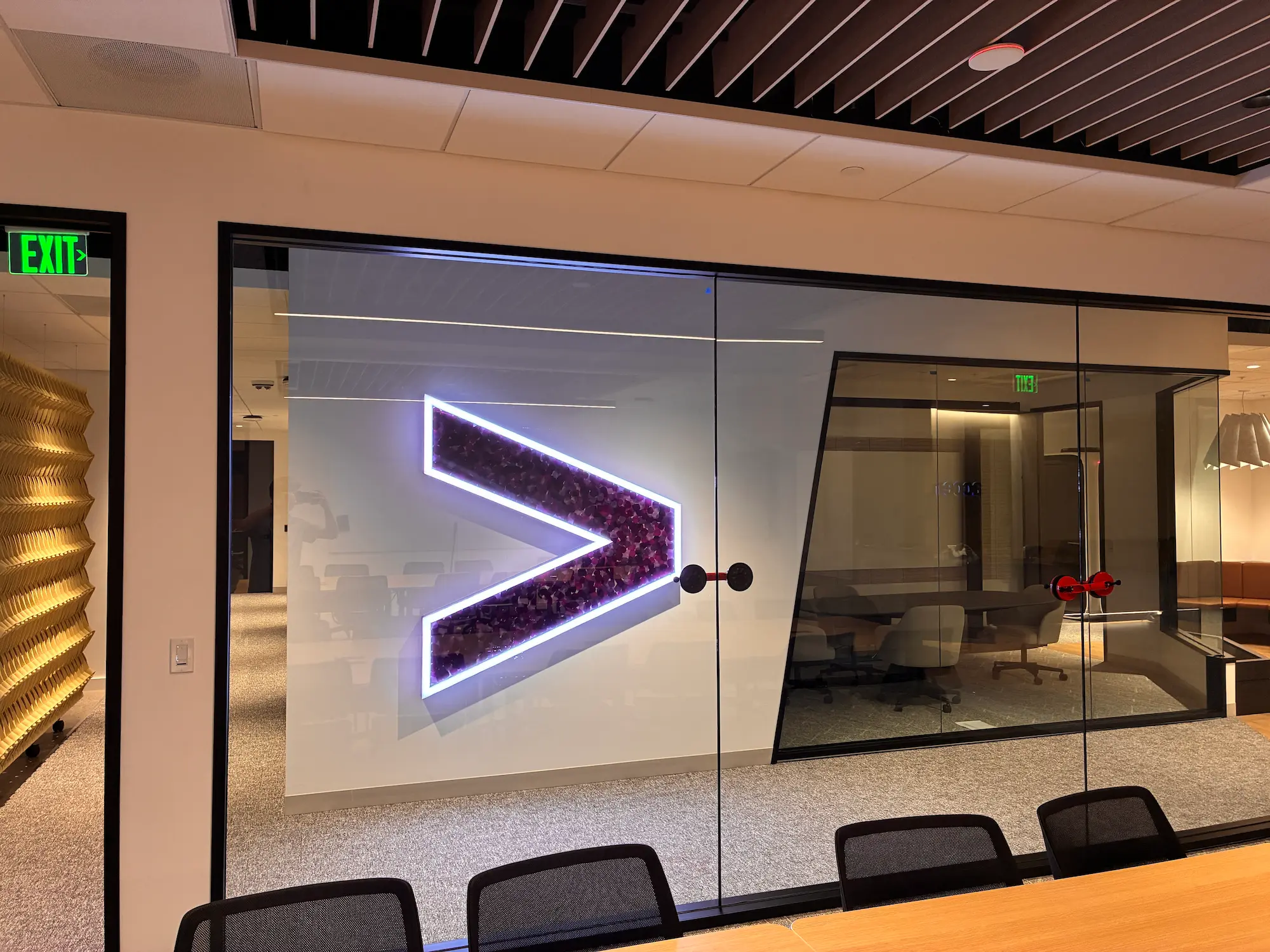
Highway 85 has built permanent interiors and branded environments for some of the most demanding clients in the country. From the Accenture Dallas office with its geometric conference room feature walls and custom infinity mirror logo installation, to the Harley-Davidson of Scottsdale showroom with its full-building brand integration, to the Bridgecrest reception area with its layered wood and living greenery feature wall, these projects have taught us lessons that no amount of pre-project planning fully prepares you for.
Here is what we have learned.
The brief is the most important document on the project. Every problem we have seen in fabrication traces back to an unclear brief. When the goals, audience, brand standards, and success criteria are locked in early, every subsequent decision has a reference point. When they are not, the project drifts. Materials get chosen for the wrong reasons. Design decisions get made by committee. The finished space feels like it belongs to several different visions instead of one.
Details communicate standards. The quality of a commercial interior is read in the small things: the way a seam is handled, the precision of a mounted element, the consistency of a finish across multiple panels. Visitors and employees do not consciously audit these details, but they unconsciously register the feeling they create. A space that is finished precisely communicates that the organization takes quality seriously. A space with rough edges communicates something else, even if the concept was strong.
Installation is where the project is won or lost. We have seen well-fabricated pieces lose their impact in a sloppy install. Alignment, leveling, lighting adjustment, and clean finishing at the end of the job are what make a project feel premium versus almost right. The fabricator who built the pieces should own the install. Handoff gaps between production and field teams are where quality slips.
Budget conversations should start with goals. The most productive client relationships we have are with organizations that come to us with a clear objective and an open mind about how to achieve it. When conversations start with a hard number and a wish list, we spend the project making tradeoffs. When they start with a goal, we spend it building solutions. The budget follows the strategy. It almost never works the other way around.
The space keeps working after the project is done. A permanent branded environment is not a one-time investment. It is a daily touchpoint for employees, clients, prospects, and visitors. The organizations that treat it that way get the most out of it. They plan for updates, build in flexibility where the brand might evolve, and choose materials that hold up under real-world use. The ones that treat it like a renovation project end up refreshing sooner than they planned.
Frequently Asked Questions
What is commercial interior fabrication? Commercial interior fabrication is the custom design and building of branded interior elements for business environments. It includes dimensional signage, feature walls, custom millwork, environmental graphics, wayfinding systems, and permanent branded installations. Unlike off-the-shelf solutions, fabrication is tailored to the specific brand, space, and experience goals of each project.
How long does a commercial interior fabrication project take? Timelines vary based on scope, complexity, material lead times, and approval cycles. A focused project covering one or two spaces may move in four to six weeks. A larger multi-floor or multi-building rollout with custom fabrication and phased installation can take several months. The biggest variable is usually approval speed and scope changes after engineering begins.
What affects the cost of a commercial interior fabrication project? Cost is shaped by the number of spaces involved, the level of custom fabrication required, material and finish selections, engineering complexity, installation conditions, and timeline constraints. A simple graphics and signage package will cost significantly less than a full environment with custom millwork, dimensional elements, integrated lighting, and specialty finishes.
What is the difference between commercial interior fabrication and interior design? Interior design focuses on how a space looks, functions, and flows. Commercial interior fabrication connects that space to brand strategy, turning design intent into physical reality. A fabricator translates approved designs into production-ready elements, manages engineering and material sourcing, builds the components, and installs them. The two disciplines work together, but they are not the same thing.
When does a space need a permanent installation versus a temporary build? Permanent installations are the right choice when the space is used daily, the brand story is stable, and the investment needs to perform over multiple years. Temporary builds are better suited for events, trade shows, pop-ups, and campaigns where flexibility, portability, and short-term use matter more than long-term durability.
What should I look for when choosing a commercial interior fabricator? Look for full-scope capability across design translation, engineering, fabrication, and installation. Ask to see completed projects rather than renderings. Evaluate their communication style and process discipline. The right partner surfaces problems early rather than delivering surprises on install day.
Can commercial interior fabrication be done in phases? Yes. Phased rollouts are common, especially in occupied environments where disruption needs to be minimized. A well-planned phased approach allows organizations to prioritize high-impact spaces first, manage budget across multiple periods, and expand the branded environment over time without starting over.
How do you maintain a branded interior over time? Material selection at the outset determines how much maintenance a space requires. Durable substrates, protective coatings, and finishes chosen for the specific use case reduce long-term upkeep. Most permanent interior elements can be refreshed or updated without a full rebuild if flexibility is built into the original design.
What industries benefit most from commercial interior fabrication? Any industry where the physical environment shapes how people experience the brand. Corporate offices, retail stores, hospitality venues, automotive dealerships, museums, aquariums, zoos, healthcare facilities, educational institutions, and government or civic spaces all benefit from intentional branded environments. The common thread is that the space plays a role in how the organization is perceived.
What is the biggest mistake organizations make with commercial interior fabrication projects? Starting too late and treating fabrication as a decorating decision rather than a brand strategy decision. Organizations that bring fabrication partners into the planning process early get more cohesive results, fewer surprises, and better use of their budget. Those that treat it as a finish-line task often end up with spaces that look fine but do not work as hard as they should.
Ready to Build a Space That Works as Hard as Your Brand?
Commercial interior fabrication is one of the highest-leverage investments a brand can make in how it shows up in the physical world. When it is planned strategically, fabricated precisely, and installed with care, the result is an environment that communicates identity, builds trust, and performs every single day.
Highway 85 has built branded environments for corporate offices, retail locations, hospitality venues, dealerships, museums, and campuses across the country. We bring the fabrication expertise, the project management discipline, and the installation capability that turns ambitious interior concepts into finished, polished environments that work.
Connect with the Highway 85 team to start planning your next commercial interior project.