

Trade shows put your company in front of a lot of people very quickly. Most of them are distracted, tired, and deciding where to stop in a matter of seconds. This article is for exhibitors who want their signage to support real conversations, not just fill wall space.
Custom trade show signs are part of your overall trade show booth design, not an add-on. When they are planned correctly, they help the right people understand what you do before your staff ever says a word.
Why Trade Show Signs Matter in the First 10 Seconds
Attendees rarely approach a booth without a reason. They scan the aisle while walking and make fast judgments about relevance.
A strong sign answers at least one of these questions immediately:
-
What does this company do?
-
Is this relevant to my role or industry?
-
Is it worth stopping here instead of the next booth?
If your signage cannot communicate something useful from a distance, it becomes visual noise.
What a Trade Show Sign Is Actually For
Trade show signs are not sales decks or brochures. They are filters.
Their job is to:
-
Establish your category
-
Signal who the offering is for
-
Set expectations for the conversation
This is why signage should work hand in hand with your trade show booth design. If the message on the wall conflicts with what staff are saying, visitors lose confidence fast.
Why Too Much Copy Fails on the Show Floor
Exhibit halls reward clarity and punish effort.
Signs fail when they include:
-
Dense paragraphs
-
Long lists of features
-
Messaging that requires explanation
-
Visuals that do not relate to the product
If someone has to stop walking to understand your sign, you have already lost most of your audience.
Good signage makes the booth easier to approach. Poor signage raises friction.
Custom Signs vs. Generic Booth Graphics
Generic graphics are built to fit anywhere. Custom signs are built to fit your booth, your audience, and your goals.
Custom trade show signs allow you to control:
-
Scale and layout
-
Brand consistency
-
Photography and diagrams
-
Materials and finishes
This matters because signage sets expectations. A booth with mismatched or poorly scaled graphics signals disorganization, even if the product itself is solid.
When signage is designed alongside custom trade show displays, the entire booth feels intentional instead of assembled at the last minute.
Choosing the Right Type of Trade Show Sign
Every sign type serves a different purpose. The goal is not to use everything available, but to use what supports how people move through your space.
Hanging Signs
Hanging signs help people find you from a distance.
They work best when:
-
The exhibit hall is large
-
Sightlines are long
-
Brand recognition already exists
They should carry short messages or logos only. Detailed copy does not read well overhead.
Back Wall Graphics
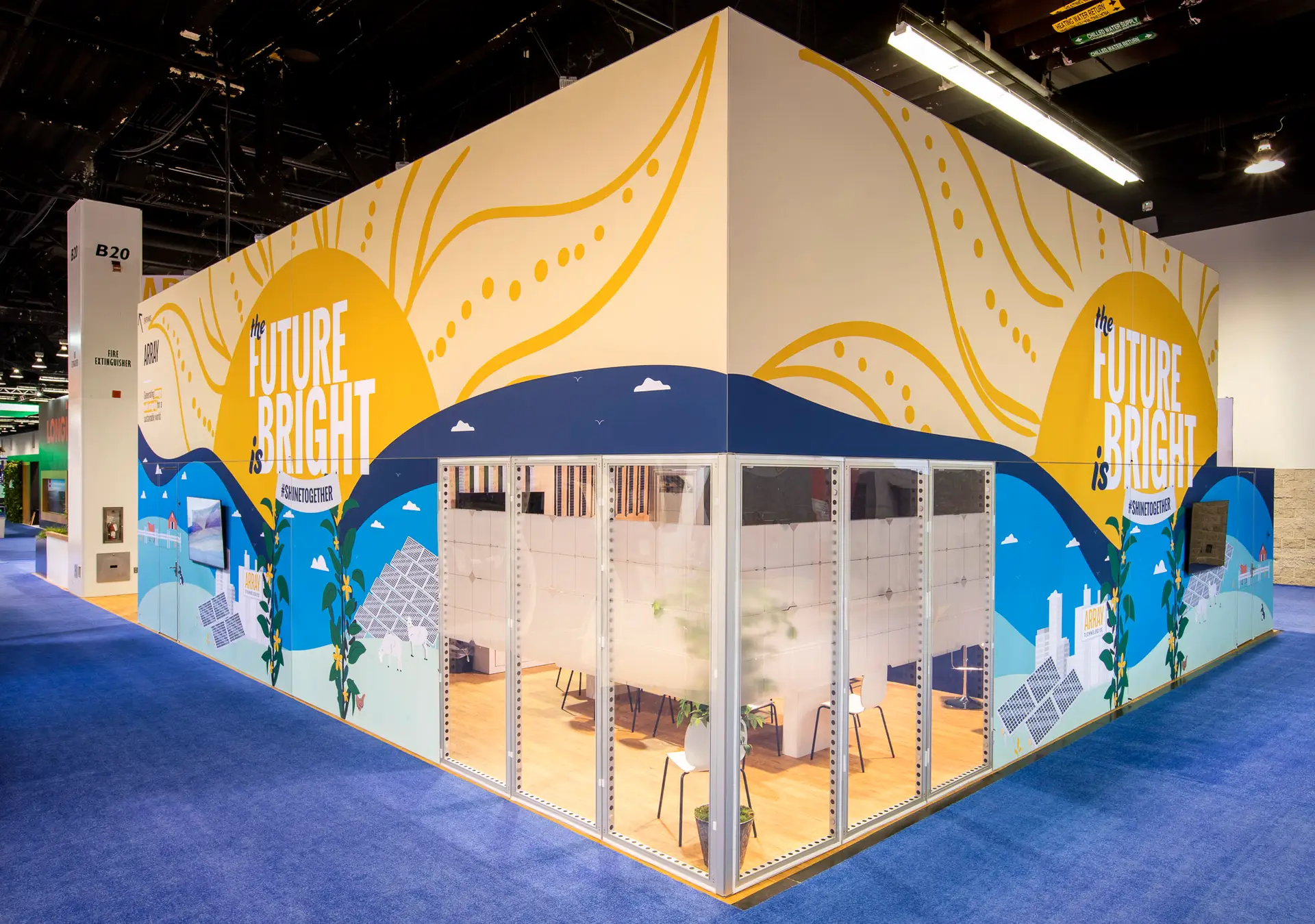
Back wall signs carry your primary message. This is the most important piece of signage in most booths.
Effective back wall graphics include:
-
One clear headline
-
Minimal supporting text
-
Strong contrast for readability
-
Imagery that reflects real use cases
If someone stands ten feet away and cannot explain what you do, the message needs refinement.
Banner Stands and Side Panels
These signs support conversations inside the booth.
They are useful for:
-
Explaining product groupings
-
Showing industries served
-
Highlighting a process or workflow
They should never compete visually with the back wall.
Floor and Directional Signs
Floor graphics and small directional signs help manage traffic.
They are helpful for:
-
Demo areas
-
Meeting spaces
-
Lead capture stations
Clear wayfinding reduces awkward movement and makes the booth easier to navigate.
Messaging That Performs on Trade Show Signs
Trade show copy needs to be specific and restrained.
Strong signage focuses on:
-
Who the product is for
-
What problem it addresses
-
How it is used in practice
Avoid vague language or internal terminology. If someone outside your company cannot understand the message quickly, it is not ready for the show floor.
Images Should Explain Something
Images should carry meaning, not just fill space.
Effective images:
-
Show the product in context
-
Reflect the customer’s environment
-
Help explain scale or function
If the image does not help someone understand your offering faster than text alone, it is not doing enough work.
Material Choices Affect Perception
Materials influence how signage looks under show lighting and how it holds up over time.
Common considerations include:
-
Matte finishes to reduce glare
-
Fabric graphics for portability
-
Rigid panels for durability
-
Vinyl for short-term or modular use
The right material depends on how often you exhibit and how the booth is transported.
A Practical Decision Checklist
Before approving any custom trade show sign, review the following:
-
Can the main message be understood in three seconds?
-
Is text readable from at least ten feet away?
-
Does the imagery clearly relate to what we sell?
-
Is branding consistent with our booth and collateral?
-
Does at least one sign include a URL or company name?
-
Will this work with our overall trade show booth design?
If several answers are no, revise before production.
Quick Take
Trade show signs should reduce effort for attendees. Clear messaging, controlled layouts, and thoughtful placement outperform clever copy every time. When signage aligns with your custom trade show displays, the booth becomes easier to understand and easier to enter.
Common Signage Mistakes
-
Treating signs as places to explain everything
-
Using fonts that do not scale well
-
Ignoring how people stand and move in the booth
-
Designing signs in isolation from the booth structure
Most of these issues show up early when reviewing full-scale proofs.
FAQs About Custom Trade Show Signs
How many signs does a booth need?
Enough to communicate the main message and support conversations. Most booths need one primary sign and a few supporting pieces.
Should every sign include contact information?
At least one should. Company names and URLs help attendees remember you later.
How far in advance should signage be planned?
Eight to twelve weeks before the show allows time for revisions, production, and shipping.
Are larger signs always better?
No. Size only helps if the message is clear and readable.
Can signage be reused across shows?
Yes, especially when built as part of modular custom trade show displays.
Should signage change for different audiences?
When possible, yes. Industry-specific messaging usually performs better.
Planning Your Next Custom Trade Show Sign
Custom trade show signs should be planned early and designed as part of the full booth system. When signage supports how your team actually sells and demonstrates, it reduces friction and improves booth flow.
Ready to Move Forward?
If you are preparing for an upcoming event and want signage that works with your booth, your staff, and your goals, get experienced input before anything goes to print. The right decisions are easier to make when signage and custom trade show displays are planned together.