


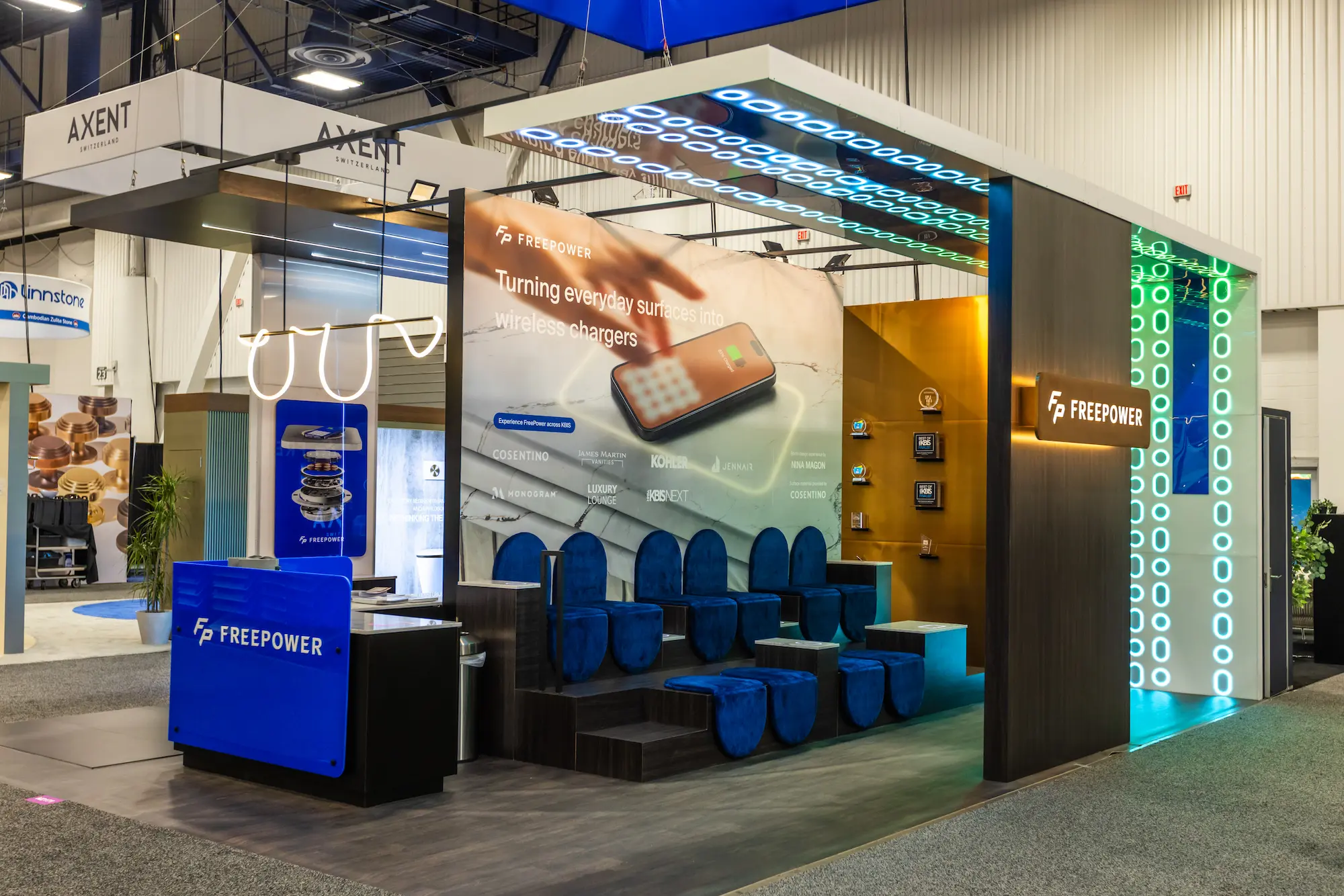
There is a persistent myth in the trade show industry: that a bold creative concept is the primary driver of booth success. A striking visual identity, a clever theme, a memorable tagline – these are the things exhibitors obsess over in the months leading up to a show. And while creative matters, it is rarely the variable that separates a high-performing exhibit from a forgettable one.
What actually determines performance on the show floor is production quality and execution. How the booth is engineered. How materials hold up under real-world conditions. Whether the build arrives on time, goes up without chaos, and presents itself flawlessly to the first visitor who walks through the door. These are the unglamorous details that win business – and the ones most often underestimated.
This guide is a definitive look at why production-led trade show execution matters, how to evaluate it, and what we have learned from decades on the show floor.
Table of Contents
- 1. The Production-Performance Link
- 2. What “Production Quality” Actually Means
- 3. Execution: The Variable Nobody Talks About
- 4. Common Production Failures and Their Real Costs
- 5. How to Evaluate a Fabrication Partner
- 6. Lessons from the Show Floor
- 7. Frequently Asked Questions
1. The Production-Performance Link
Walk any major trade show – HIMSS, CES, PACK EXPO, IMTS – and you will immediately notice that the booths commanding the most attention are not necessarily the ones with the most inventive concepts. They are the ones that feel real. Solid. Intentional. Every element – the countertops, the lighting rigs, the hanging structure, the graphics – communicates that the company behind the booth means business.
This is not accidental. It is the direct result of production discipline.
Research consistently shows that trade show visitors form impressions within the first three to five seconds of approaching a booth. In that window, no one is reading your tagline or processing your brand story. They are responding to physical cues: the quality of materials, the precision of the build, whether the space feels considered and professional. Production quality is the first message your exhibit sends – before any sales conversation ever begins.
“Visitors decide whether to enter your booth in seconds. What they’re responding to is physical quality – not your brand promise.”
The link between production and performance operates at multiple levels. At the macro level, a well-executed exhibit positions your company as a credible, serious player – an important signal in competitive markets where buyers are evaluating vendors in real time. At the micro level, execution details like sightlines, traffic flow design, and the placement of interactive elements directly affect how many conversations your team can have and how productive those conversations are.
2. What “Production Quality” Actually Means
Production quality is often misunderstood as a synonym for “expensive.” It is not. Poorly executed premium materials still produce a poor result. Well-engineered modest materials can produce an exceptional one. Production quality is about the relationship between design intent and physical reality – how accurately and durably the intended experience is manifested in a build.
In practical terms, it breaks down across several dimensions:
Materials and Fabrication Standards
The materials your exhibit is built from determine how it looks, how it holds up through repeated setup and teardown cycles, and how it responds to the unpredictable conditions of a show floor – humidity, temperature changes, the stress of shipping and handling. Structural elements need to be engineered with appropriate tolerances. Surface finishes need to be selected for durability, not just initial appearance.
Common quality differentiators include: the gauge of aluminum extrusions, the quality of laminate adhesion on graphic panels, the precision of CNC-routed components, the caliber of hardware used in connection points, and the finishing quality on painted or textured surfaces. These details are invisible to the untrained eye – until they fail.
Graphic Production and Color Management
Graphics are among the most scrutinized elements of any exhibit, and among the most frequently compromised in budget negotiations. The gap between a digital mockup and a printed, installed graphic can be significant. Rigorous color management, output calibration, substrate selection, and finishing choices (lamination, mounting method) all determine whether your graphics look exactly as intended under the harsh, mixed-lighting conditions of a convention hall.
Resolution standards matter. Bleed and tolerance specifications matter. The difference between a graphic that looks flat and tired versus one that punches visually across the aisle is often a production decision made weeks before the show.
Technology Integration
Screens, interactive kiosks, LED walls, and AV systems are now standard components in mid-to-large trade show exhibits. The quality of their integration – cable management, mounting stability, signal reliability, heat management – is a major determinant of the attendee experience. A glitching screen or a kiosk that freezes is not a minor inconvenience. It is a brand impression, and a negative one.
High-production-quality technology integration means components are tested extensively before the show, installed with professional-grade hardware, and backed by on-site support plans.
Structural Engineering and Safety
Hanging structures, multi-story exhibits, large canopies, and heavy suspended elements require engineering documentation and, in most major venues, structural review and certification. Production quality here is not optional – it is a matter of compliance and safety. Exhibits that fail engineering review cause costly delays and emergency redesigns. Those that never went through engineering at all represent a genuine liability.
3. Execution: The Variable Nobody Talks About
If production quality is about what is built, execution is about how it gets to the floor and how it performs there. Execution encompasses the entire operational arc of an exhibit program: project management, logistics, labor coordination, installation, show services management, and strike.
Execution is where most trade show programs succeed or fall apart – and it is the dimension least visible in pre-show planning conversations.
Project Management and Lead Times
Trade shows operate on immovable deadlines. The show opens whether your exhibit is ready or not. This reality makes project management a core competency, not a background function. Effective project management means maintaining realistic production schedules with built-in contingency, proactive communication about risk, and clear accountability across fabrication, graphics, shipping, and on-site labor teams.
Compressed lead times – which are increasingly the norm – demand experienced project managers who know exactly where schedule risk lives and how to manage around it. The difference between a 10-week and an 8-week lead time is not 20% less time. It is the elimination of contingency buffer, which means every upstream decision must be made faster and more accurately.
Logistics and Freight Management
An exhibit can be flawlessly built and still fail if it arrives late, arrives damaged, or arrives at the wrong dock. Trade show logistics is a specialized discipline involving advance warehousing, crating specifications, carrier coordination, and meticulous tracking. Freight that misses advance warehouse deadlines results in direct-to-show delivery – which typically means significantly higher material handling costs and a smaller window for installation.
Proper crating is an often-overlooked investment. Exhibits that are improperly packed suffer damage in transit – and that damage is usually discovered at the worst possible time, the morning of installation.
Installation and Labor Coordination
Show floor installation is among the highest-stakes phases of any exhibit program. Labor rates at major venues are significant, installation windows are finite, and the complexity of coordinating electricians, carpenters, riggers, and AV crews in a compressed timeframe requires experienced supervision.
The quality of installation documentation – detailed drawings, assembly instructions, hardware manifests – directly determines how efficiently labor can work. Incomplete or ambiguous documentation leads to on-site problem-solving that consumes time and budget. The best installation supervisors are those who have overseen enough builds to anticipate problems before they occur.
Show Services Management
Every show involves a web of contractor relationships – the general service contractor, electrical contractor, rigging company, internet provider, cleaning services, and more. Managing these relationships – ordering correctly, coordinating access, resolving issues – is a significant operational burden. Experienced exhibit houses manage this complexity as a standard service. Exhibitors who manage it themselves for the first time invariably discover how much time and money it consumes.
4. Common Production Failures and Their Real Costs
Understanding what can go wrong – and what it actually costs when it does – is essential context for understanding why production quality investments pay off.
Graphics That Don’t Match the Design
Color shift between digital design and printed output is the most common production failure in trade show exhibits. It results from poor color management practices, incorrect substrate selection, or inadequate proofing. The cost is not just aesthetic – it affects brand perception, undermines the investment in design, and often cannot be corrected on-site.
Structural Failures and Safety Issues
Components that do not fit together correctly, structural elements with insufficient load ratings, hanging structures that fail venue engineering review – these failures are costly in every sense. In the worst cases, they create safety hazards. In all cases, they create expensive and stressful show-floor emergencies.
Technology Failures
Screens that don’t display correctly, touchscreens that are unresponsive, AV systems that lose signal, Wi-Fi-dependent demos that fail due to the notoriously congested wireless environment of a convention hall – technology failures are among the most visible and damaging problems in a trade show booth. They communicate operational incompetence at the worst possible moment.
Delays and Last-Minute Scrambles
When production falls behind schedule, the entire program is compressed. Rush freight costs. Overtime labor costs. The stress on your team is significant, and the likelihood of errors increases. Booths that are completed in a scramble rarely look as good as booths that were built with time for quality review. And the booth that is still being finished when the doors open is a story your sales team will tell for years – for all the wrong reasons.
5. How to Evaluate a Fabrication Partner
Choosing the right exhibit fabrication and execution partner is one of the most consequential decisions in an exhibitor’s trade show program. Here is a framework for evaluation that goes beyond portfolio review.
Production Capabilities and Facility
Visit the fabrication facility if possible. The quality of a shop tells you a great deal about the quality of the work. Look for organized material storage, calibrated equipment, clear finishing areas, and evidence of systematic quality control. Ask about the range of materials and fabrication methods available in-house versus outsourced. Outsourced fabrication is not inherently problematic – but it adds coordination risk and should be disclosed.
Project Management Process
Ask prospective partners to walk you through their project management process for a program of your complexity. What does their internal milestone structure look like? How do they communicate with clients during production? How do they handle schedule risk? What is their change order process? The answers will tell you whether project management is a real competency or a marketing claim.
References from Comparable Programs
References matter most when they come from programs comparable to yours – similar scale, similar complexity, similar show profile. Ask specifically about what went wrong on a project and how the partner responded. Every complex project has challenges. A partner who can articulate how they navigated a difficult situation is far more valuable than one who claims all their projects run perfectly.
On-Site Service and Support
Who will be on-site during your installation and show? What is their experience level? Who is your point of contact if something goes wrong at 9 PM the night before the show opens? The quality of on-site support is often the most critical differentiator between exhibit partners and the hardest to evaluate from a distance.
Post-Show Asset Management
What happens to your exhibit after the show? How is it inventoried, inspected, stored, and maintained? Poor post-show handling is how exhibit assets degrade prematurely. A partner with rigorous inventory and maintenance protocols protects your investment and ensures your exhibit looks right at every subsequent show.
6. Lessons from the Show Floor
The following insights come directly from experience managing complex exhibit programs across venues ranging from McCormick Place and the Las Vegas Convention Center to international shows in Europe and Asia. These are the things you learn by being on the floor – repeatedly, under pressure.
The First Impression Is Set Before Anyone Walks In
Attendees begin evaluating your booth before they enter it. Sightlines from the aisle – what the exhibit looks like from 20, 30, 50 feet away – determine whether they change course to engage or continue walking. This means production quality at the macro level (overall structure, dominant visual elements, lighting presence) matters as much as close-up detail work. Investing heavily in interior finishes while neglecting the exhibit’s aisle presence is a common and costly mistake.
Every Hour of Delay Costs More Than You Think
On a show floor, time is not just money – it is stress, decision-making quality, and team readiness. When installation runs long, your sales team is distracted, your management is reactive, and the focus shifts from preparation to problem-solving. We have seen well-funded exhibits fall short of their potential not because of design or product, but because the team arrived at opening day exhausted and flustered from a difficult install. The cost of schedule failures extends well beyond the direct labor and freight invoices.
Lighting Is the Single Highest-Impact Variable
If you can only invest in one production upgrade, invest in lighting. The difference between a conventionally lit exhibit and one with professionally designed and executed lighting is dramatic – and immediate. Lighting affects how products look, how graphics read, how the space feels to someone standing inside it, and how prominently the exhibit registers in the visual noise of a crowded show floor. Lighting design deserves as much attention as any other production discipline.
Your Competitors Are Investing
The production quality bar at major industry shows continues to rise. What looked excellent five years ago looks average today. This is not an argument for perpetual escalation – it is an argument for strategic investment and regular refresh cycles. Exhibitors who let their properties age without updating risk the perception of stagnation, which is particularly damaging in categories where innovation is the primary selling proposition.
Pre-Show Rehearsal Is Not Optional
Assembling a complex exhibit in a warehouse before it ships is one of the most valuable investments an exhibitor can make. A full pre-show build reveals fit and finish problems, technology integration issues, and assembly sequence problems before they appear on the show floor, when time and repair options are both severely constrained. The cost of a pre-show build is almost always less than the cost of the problems it prevents.
7. Frequently Asked Questions
How much does production quality actually affect ROI?
The relationship is real and measurable. Studies of trade show performance consistently show that booth traffic, lead quality, and post-show brand recall correlate with physical exhibit quality. Beyond metrics, the commercial logic is straightforward: trade shows are competitive selling environments where first impressions drive engagement. Production quality determines that first impression. An exhibit that looks credible and serious attracts more and better conversations, and those conversations are what generate pipeline.
We have a limited budget. Where should we prioritize production quality?
Prioritize in this order: structure and overall visual presence, lighting, and graphics. In that sequence. A well-lit, structurally clean exhibit with good graphics will outperform a more elaborate exhibit with poor lighting and mediocre build quality. Technology and elaborate interactive elements come later in the priority list – they add value only when the foundational production quality is already solid.
How far in advance should we begin production planning?
For a custom exhibit of 400 square feet or larger, 16 to 20 weeks is a responsible minimum lead time from signed approval to show-ready delivery. Smaller inline exhibits can often be turned in 10 to 12 weeks. These timelines assume design approval is achieved efficiently – extended design revision cycles are among the most common causes of compressed production schedules.
What should we look for in a pre-show build review?
During a pre-show build, evaluate: structural assembly accuracy and ease, fit and finish quality on all components, graphic installation quality and alignment, technology integration and functionality, lighting performance and coverage, and traffic flow logic. Walk through the exhibit as an attendee would, from the aisle to the interior, noting anything that does not feel right. This is also the time to confirm all assembly documentation is complete and accurate.
How do we protect our exhibit assets to maximize their lifespan?
Asset longevity begins with smart storage and handling. All components should be inventoried after each show, inspected for damage, cleaned, and properly crated for storage. A professional exhibit house will provide condition reports and proactive recommendations for refurbishment or replacement. Graphics have a shorter lifespan than structural components and should be budgeted for refresh every two to three show cycles at minimum.
Is renting a better option than owning for quality control?
Rental can be a quality-positive choice in the right circumstances – specifically, when the rental inventory is well-maintained and the rental partner provides full installation service. The risk with rental is that you have less control over component condition and customization depth. For exhibitors with consistent show programs and significant brand investment, ownership with a strong asset management program typically delivers better quality control and better economics over a three-to-five year horizon.
Conclusion
Creative concepts open doors – they give your exhibit a reason to exist and a story to tell. But it is production quality and execution that determine whether that story gets told. A great concept improperly executed is a missed opportunity. A thoughtful concept flawlessly executed is a competitive asset.
The exhibitors who consistently perform best at trade shows are the ones who treat production and execution as strategic disciplines, not operational details. They invest in the right fabrication partners, build time into their programs for quality review, and approach every show with the same rigor they apply to their product launches and sales strategies.
The show floor is unforgiving. It rewards preparation and punishes shortcuts. Production quality is not overhead – it is your first and most powerful selling tool.